
In the photo above, the Atala butterfly is checking out sweet Carla as a nectar source!
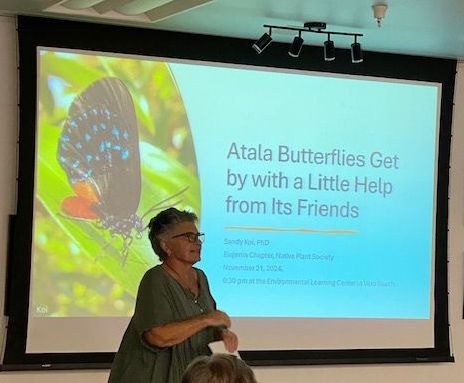
Eugenia Chapter’s November 21, 2024 speaker was Dr. Sandy Koi. She gave an enthusiastic and informative presentation focusing on her 10 year’s worth of research on the Atala butterfly (Eumaeus atala).
Sandy’s research encompassed 479 Atala colony sites: 51% of those were home gardens (just like ours!). Key points indicated that coonties (in any number) needed to be present for a larval food source. If your coonties (Zamia integrifolia) are eaten to the point of total defoliation (see below), do not fret; you’ve done your part to perpetuate the species! The coontie plant will grow back with a new season’s “flush”.
Canopy trees proved to be very important for roosting, socializing, and mating (you might be surprised what you see when you look up!). For the adults, plant diversity was more important than solely a native plant habitat.
Adults seeking nectar were most attracted to plants with white flowers. We have seen many of these during yard tours: white indigoberry (Randia aculeate), beggarticks (Bidens alba), shiny-leaf coffee (Psychotria nervosa), fiddlewood (Citharexylum spinosum), and dahoon holly (Ilex cassine).
If you were unable to attend this meeting and wish to learn more about what you missed, click here to access this comprehensive IFAS publication.
“I can’t believe I ate the whole plant” says the coontie larva below!

 ircnativeplants.org