

Eugenia Chapter’s May 15, 2025 yard walk took place at the residence of Tom Brown on Benedictine Terrace in Sebastian. If you weren’t able to attend, just driving by will give you an idea of what a wonderful diversity of native plants Tom has cultivated on what was originally a barren lot.
He has truly embraced the mantra “less turfgrass is better” by using a variety of ground covers, wild flowers, and mulched areas. I think his native plant yard is a success since a gopher tortoise likes it well enough to make it a permanent home!
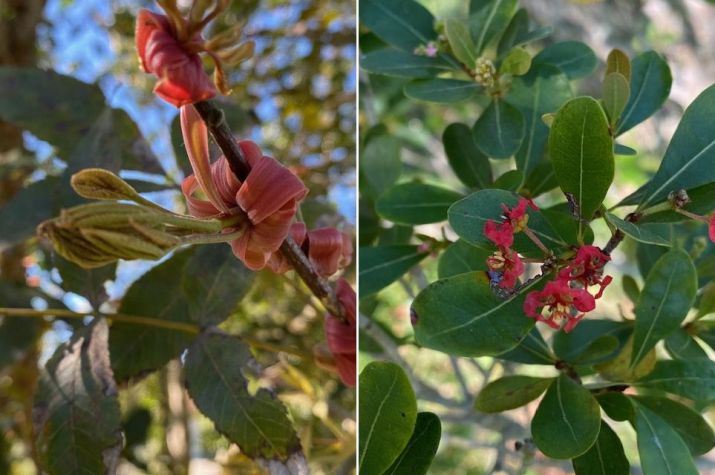
Tom’s “forest” of slash pine (Pinus elliottii) in the back corner of his lot motivated me to plant 12 of my own! I’m envious of his wonderful pignut hickory (Carya glabra), above left, and his cinnamon bark (Canella winterana), above right. Both of these trees have such interesting flowers.
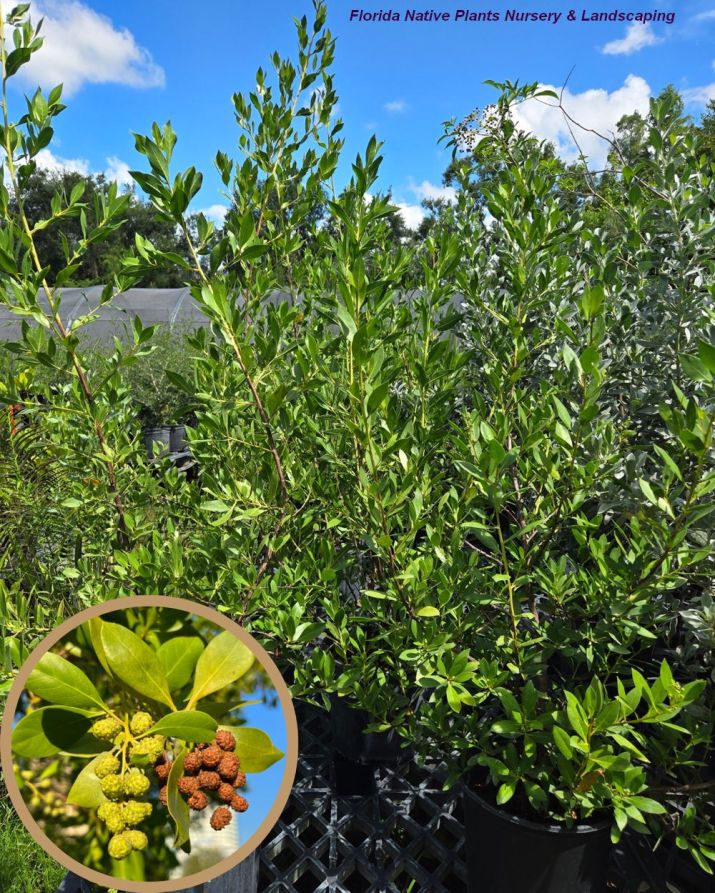
I’d like to highlight what I think is an unsung hero of our native plant palette, the green buttonwood (Conocarpus erectus). In Tom’s yard, it is located on the left side of his property. He has allowed it to grow into a spreading tree form which provides a nice barrier and great shade. He has used it to hang up orchids and Tillandsias. Note the fruit, i.e. the “buttons”, pictured in the insert.
This hardy, versatile, small tree can be used as Tom has done or, since it takes so well to trimming, it can be limbed up opening the area underneath for sitting, hardscapes, or even under plantings that require shade. In recent years, I’ve noticed it being frequently used for hedge plantings, whereby it is easily topped. However, if you are going to try using it for a hedge plant, consider also using 1 or 2 other natives to provide more diversity and visual interest than just the green buttonwood by itself. We need to get away from the straight hedge only look and use more grouped plants for privacy/buffer plantings. A good example of this can be seen on the right side of the entrance road to the Environmental Learning Center.
 ircnativeplants.org