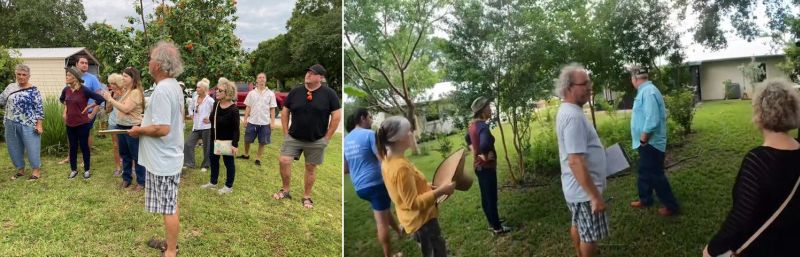

Eugenia Chapter’s June yard walk got off to a shaky start for some participants. Once again, the County had a road blocked off, and some drivers had difficulty finding a detour route to get to our host’s yard. Still, a couple dozen native plant enthusiasts arrived safely, albeit, for some, a bit late.
Ricky Ray, our host, is a man of many “hats”. Our group was visiting to admire his native plant collection which continues to grow at a rapid rate. Many of our members are also aware of his musical expertise since he performs at several local venues. Ricky is also a member of our allied organization, Pelican Island Audubon Society where he volunteers his (no) spare time to helping out in the native plant nursery, and leading hiking and birding tours. Now I’m also wondering if he has some hidden chef talents since he generously donated some Cuban oregano plants as bonus additions to our native auction plants.
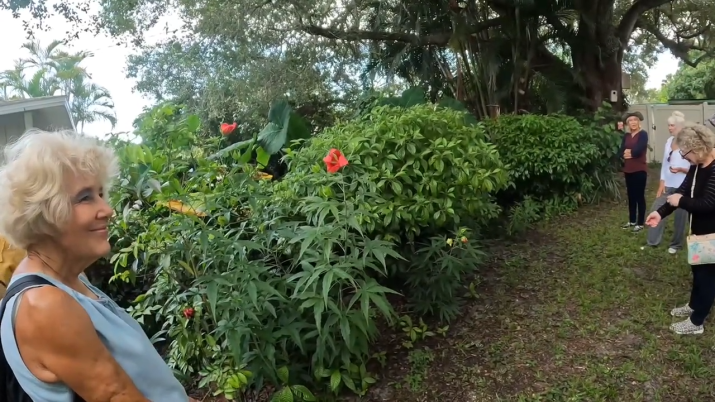
A native plant that jumped out at everyone was the flashy scarlet hibiscus/scarlet rosemallow (Hibiscus coccineus). Besides providing such a riot of color, the flower is a source of both nectar and pollen for hummingbirds. Ricky has a healthy group of them growing in ground. However, this is one of the few native plants that will grow well in a pot. The plant does best when kept evenly moist Place a saucer underneath the pot and let it hold water. Scarlet hibiscus sets seed, so make sure to look for the pods and harvest the seed so you can grow more plants to donate to one of our auctions and give to your friends. The plant will die back in the winter, but just wait until Spring when new growth will appear. Read more information about this attractive plant at this Florida Wildflower Foundation link: https://www.flawildflowers.org/flower-friday-hibiscus-coccineus/
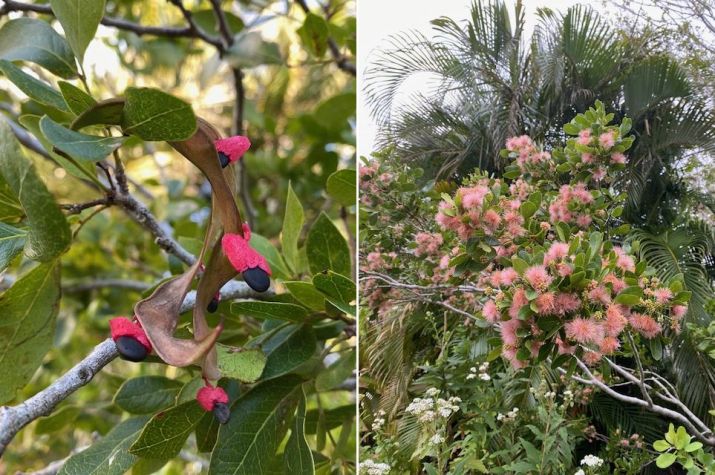
When I visited Ricky’s yard, I was so excited to see that he had added blackbead (Pithecellobium keyense) to his collection. It will be a couple of years before his plant will look like the one featured from my yard in the picture above, but it is worth the wait. Since many of the native plant enthusiasts in our area are not familiar with blackbead I thought some promotional information was in order in hopes more of you would incorporate this plant into your landscape.
The plant is named after the shiny black seed which is used in jewelry making. In the photo on the left you can easily see the seeds attached to that red, fleshy-looking material which is called the aril. Arils help attract animals that seek them as a food source, and thus, that helps with the seed distribution.
On the right are the beautiful, delicate clusters of blossoms which, if set properly, will develop into green pods that mature into the seeds. What you can’t tell from the photo is the delightful, strong fragrance of those blossoms.
Blackbead can be used in the landscape as a branching shrub with twisting, thin trunks or a small tree, under 15’ tall. Since it has short thorns, it is best used as a part of a buffer planting or out of the way of foot traffic.
Blackbead is the larval host plant for Cassius Blue and Large Orange Sulfur butterflies. However, it is a nectar plant for a multitude of Florida native butterflies and other insects. Plus, those seeds are such a welcome treat to birds. Diversity is so important for feeding the wildlife, and this plant has much to share.
Thanks to Terri Privett, who some of you may have noticed was filming during the yard tour. I captured screen shots off her YouTube posts to use for this blog post.
 ircnativeplants.org