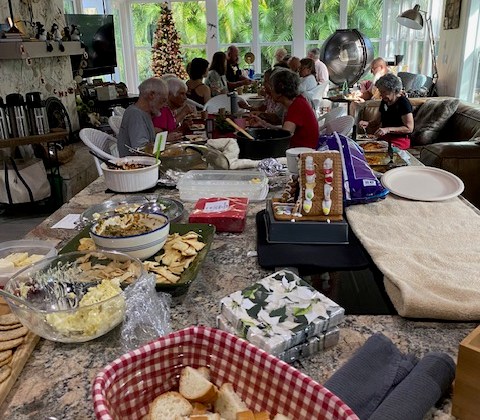

If you didn’t attend Eugenia Chapter’s holiday party, you missed three great holiday deals: wonderful company, good food, and a native plant yard tour.
MUCH thanks to Carla and Charlie Flournoy for hosting the event at their lovely home. Their bright and cheery family room provided the perfect setting for social interaction and easy access to the sumptuous and diverse food dishes members brought to share.
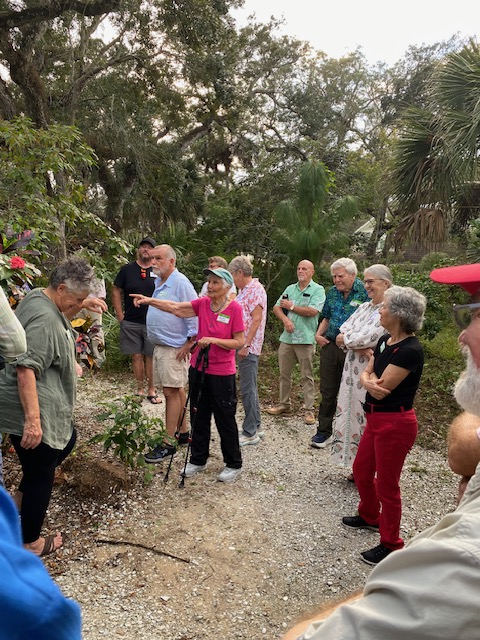
The live oak canopy habitat of the Flournoy’s neighborhood is part of the coastal maritime hammock found on the barrier island. Their native yard provides the perfect setting for several well-established understory species: Simpson’s stopper (Myrcianthes fragrans), shiny-leaf wild-coffee (Psychotria nervosa), beautyberry (Callicarpa americana), marlberry (Ardisia escallonioides), saw palmetto (Serenoa repens), and rouge plant (Rivina humilis). All of these plants are well-adapted to growing in Indian River County and are easily obtained, including from our native plant auctions.
Prominent companion species reaching up through the live oak canopy include cabbage palm (Sabal palmetto) and, currently not as noticeable, mulberry (Morus rubra) Although a “weak” woody tree, the deciduous mulberry is able to thrive in the hammock environment since the oak canopy provides good wind protection. The Flournoy’s tree is nestled tightly in the middle of their front yard where the falling fruit (if all of it isn’t eaten by all kinds of wildlife!) and the leaf drop isn’t an issue. Remember – “leave the leaves” is one of the native plant grower’s mantras. Decaying leaves are nature’s natural mulch and are integral to the living and dying cycle of all environments.
When Carla was giving the yard tour she emphasized how the appearance of her yard changes throughout the year, primarily driven by moisture and sunlight. The groundcovers, river sage (Salvia misella) and sunshine mimosa (Mimosa strigillosa), currently dormant, come into their own with both flowers and foliage as the day lengthens and temperatures warm up. All kinds of native seeds germinate and find their “place” in the landscape. Learn to recognize the seedlings; pot up what you don’t want and donate them to our plant auctions after they reach an eye-catching size.
Thanks to all who brought the delicious dishes to share. We wish everyone a wonderful holiday season and a happy, healthy, and safe 2026.
KEEP GROWING NATIVE!
 ircnativeplants.org