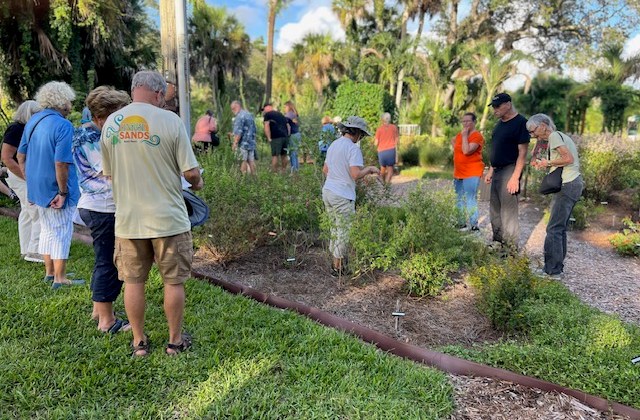

September 17, 2026: over two dozen Eugenia Chapter members and guests arrived for their 5:30 tee times for the scramble event to tour the butterfly garden at Vero Beach Country Club.
First, some background information is in order. It is not commonplace to see garden areas designated for native plants at golf facilities. Kudos to the club members who came together to form their own association within the VBCC called the Vero Beach Country Club Audubon Association. Their goal was to educate their members about the native plant and animal life seen at the Club. Part of that program allowed for the creation of both a native plant garden and a separate butterfly garden area, the area featured in this tour.
Preliminary planning took a couple of years since the site needed to be selected and prepared and irrigation lines installed. Native Butterfly Flowers worked with the group to come up with a plan, supply plant material and help with the initial planting. Dedicated and enthusiastic VBCCAA members do the maintenance on the gardens: weeding, watering, pruning, removal and replanting of plants when needed. Close inspection reveals that a lot of the plants are labeled, a real plus for everyone trying to learn the names of the plants.
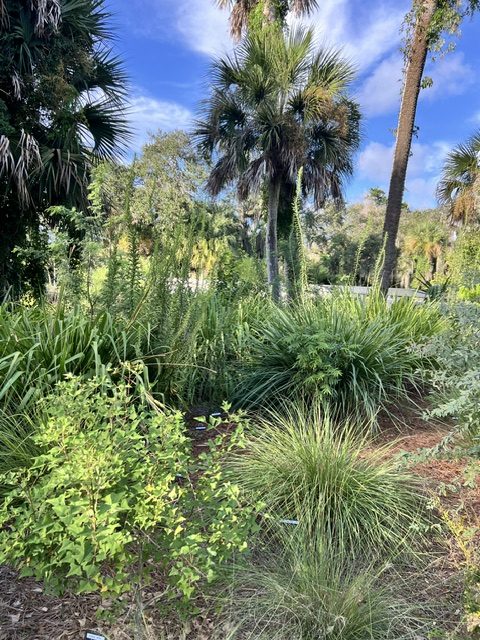
Easy to obtain, versatile, perennial bunch grasses have already come to full form. Layering provides visual appeal, with the large Fakahatchee grass (Tripsacum dactyloides) set as a backdrop to the smaller Dwarf Fakahatchee grass (Tripsacum floridanum) and muhly grass (Muhlenbergia capillaris). While the muhly grass is best known for its showy pink blossoms, that, along with the two Fakahatchee grasses provide wonderful seed sources for birds and small mammals. Even during the flowering stages, the grasses can be a useful source of pollen to foraging invertebrates. The thick, bushy growth habits of the grasses are a favorite hideout for rabbits and other small vertebrates.
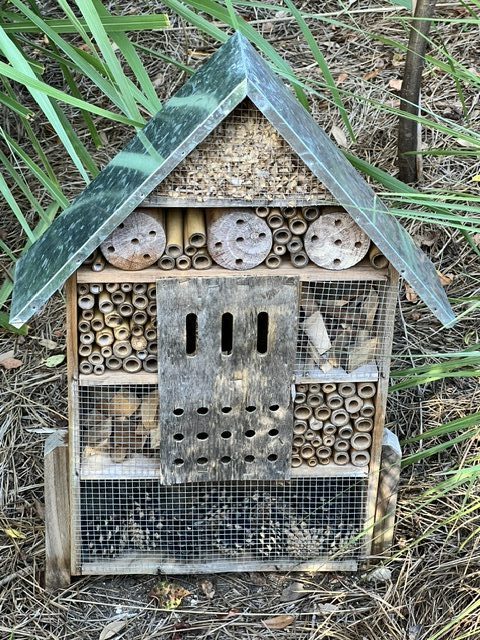
The garden has a wonderful invertebrate “nesting” box. This particular design utilizes the hollow, tubular plant pieces that are the favorite of many of our native bee species. In addition, the box has vertical openings large enough for butterfly and moth species caterpillars to enter and safely emerge after pupating. The wire mesh areas allow larval stages of invertebrates to enter, pupate, and emerge while excluding other animals that may prey upon them. Put your nesting boxes farther from the ground such that there is air space between the box and the ground; that will help keep the box from getting too wet and rotting sooner.
Adults members and their children have visited the garden and seen some of Florida’s beautiful butterflies and other interesting invertebrates. The garden is doing what it was designed to do: provide habitat and educate people, who hopefully, will spread the word to save and/or create more native areas.
Much thanks to Eugenia Chapter and VBCCAA member Julie Young for assisting with the garden tour and taking the time to provide written answers to my long list of questions.
The prediction of thunderstorms came true; it starting dumping immediately after the garden tour ended and prevented our native plant auction. Thanks to those who brought plants to auction; please bring them to our next meeting.

