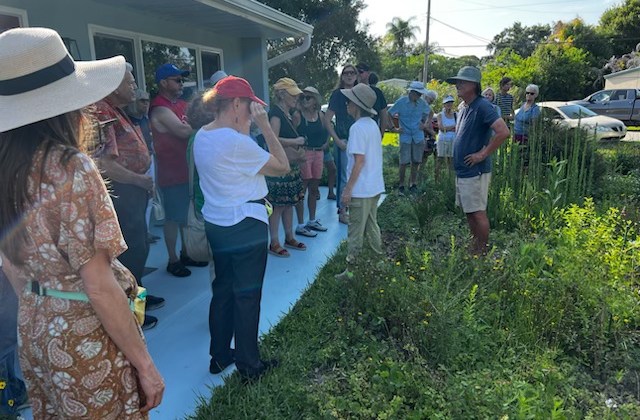

Wow, battling the heat and humidity, our Eugenia Chapter members and, always welcome, guests really showed their interests in promoting native plants and supporting our yard tour host! Almost 40 people showed up for the June yard tour at the home of Steve Palmquist.
You have to hand it to Steve for all he has solely accomplished in the last couple of years by transforming his “regular”, predominantly turfgrass and invasive weeds, yard into a diverse native plant showcase. I always tell people that we all take different approaches to how we want to utilize and display wonderful natives in our home landscapes. Steve’s yard is no exception, and offers several great take-away ideas.

I’m giving Steve a 5/5 for his extensive use of the bedding concept to landscape design. He pulled out large sections of turf, rounded out the edges and created visually appealing bedding areas. In those, he planted a diverse mix of woody plants and annuals. Until the woody plants fill up the bed space, the annuals offer nice splashes of color and readily reseed themselves in the mulched beds. The large beds make mowing the remaining turf and moving around the yard much easier than if you had to navigate in between smaller planting areas.

Steve has planted several species of native grasses. Grasses are: easy to take care of, long-lived, can be purchased small since they grow so fast (saves money and you don’t have to dig big holes), can be divided, and some will reseed themselves, if the birds don’t get them first. Also, notice (left photo) what a great barrier/screening plant they may function as. However, don’t just plant them in a straight line, single species arrangement. Plant to give height variation by mixing the species like Steve has done along the property line fence. Allow enough room for smaller plants to mix in like the Coreopsis spp. seen in the photo. Find the right place and try these native grasses: sand cordgrass (Spartina bakeri), Fakahatchee grass (Tripsacum dactyloides), dwarf Fakahatchee grass (Tripsacum floridanum), Elliot’s lovegrass (Eragrostis elliottii) and purple lovegrass (Eragrostis spectabilis), and mulhy grass (Muhlenbergia capillaris).
No native plant homeowner is going to call you out as a weirdo stalker if you slowly drive by their yard to see how things are growing. The seaside goldenrod (Solidago sempervirens) and crownbeard/frostweed (Verbesina virginica) seen in the photo on the right is worth driving by Steve’s house to see when they are blooming, displaying their spikes of yellow and puffballs of white. Both of these flowering natives attract MANY species of pollinators.
Thanks to all who contributed plants for a very successful auction. Things are growing so quickly in the summer heat and humidity, so find a shady spot to work and pot up some of your extra native plants to donate to a good cause at a future meeting.

